
Heavy Intelligence Blow by the IRGC Navy to the U.S. Fifth Fleet in the Strait of Hormuz
The Public Relations office of the Navy of the Islamic Revolutionary Guard Corps (IRGC), in an official statement, announced the capture of the second unmanned underwater vehicle (UUV) belonging to the terrorist U.S. military in the strategic waters of the Strait of Hormuz.
According to the issued statement, valiant IRGC Navy combatants, backed by precise intelligence dominance and the deployment of indigenous electronic warfare systems, were able to identify, ground, and seize this hostile spy system completely intact. This advanced system is currently in the possession of the IRGC Navy’s elite specialists and engineers for the purpose of recovering stored data and analyzing its technical architecture.
The IRGC Navy command, reiterating its comprehensive vigilance in this statement, reminded that “the Strait of Hormuz is restricted, and the Armed Forces of the Islamic Republic of Iran will decisively and unceasingly confront any dangerous, intrusive movement or unauthorized passage in this vital waterway.”
Second Catch in Less Than a Month; “Kingfish” Caught in IRGC’s Electronic Net
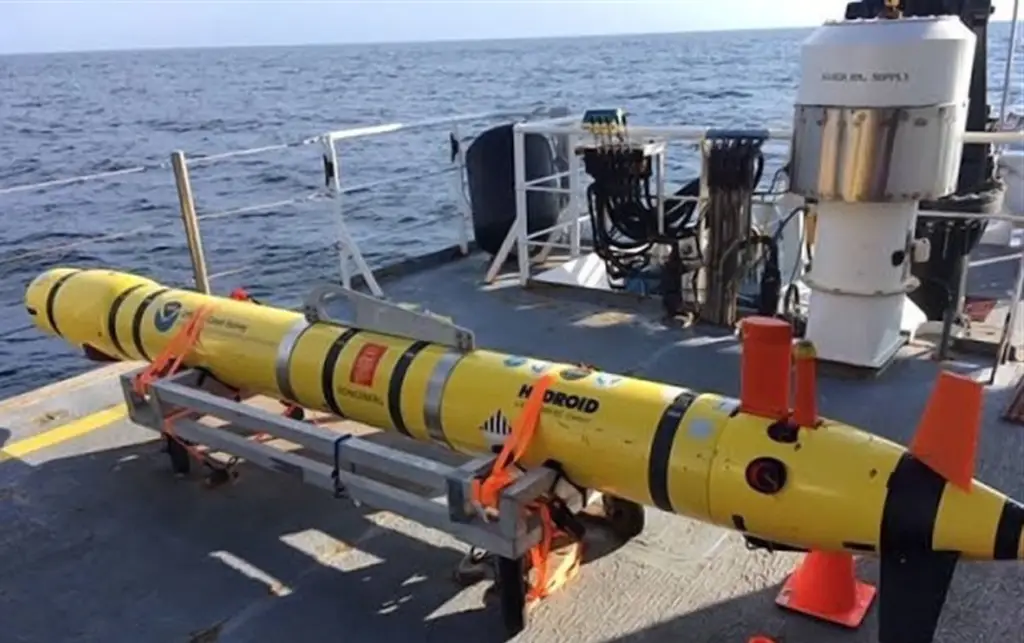
This brilliant achievement comes just weeks after the seizure of a secret “Dive LD” strategic UUV on September 7, marking the second major setback for the Yankees in the Persian Gulf’s underwater battle phase within a short period. The newly seized system is the well-known REMUS 600 model, which operates in the U.S. military under the military designation Mk 18 Mod 2 and the organizational title “Kingfish.”
Unmanned vehicles of the REMUS series—which, in addition to the U.S., are employed by the armed forces of countries such as the UK, Canada, Japan, Ukraine, and New Zealand—have been developed in various models including 100, 300, 600, and 6000; the numbers denote the system’s maximum operational depth (in meters). Thus, the REMUS 600 is capable of penetrating international waters up to a depth of 600 meters.
Technical Specifications and Utility of the REMUS 600 UUV
The REMUS 600 autonomous underwater vehicle is designed with a cylindrical aerodynamic shape and possesses the following operational specifications:
- Structural Dimensions: 4.3 meters long with a body diameter of 32.4 cm.
- Power Source: High-reliability compact lithium battery modules.
- Endurance: Over 70 hours of continuous navigation at a standard patrol speed of 3 knots (5.6 km/h).
- Maximum Speed: Capability of reaching a final speed of 9.3 km/h.
- Sensors and Probes: Equipped with advanced Side-Scan Sonar systems, high-precision ocean floor mapping sensors, and high-resolution cameras for deep-water imaging.
The modular nature of this system allows the U.S. military to install various equipment—such as reconnaissance, acoustic monitoring, and particularly sensors for detecting and locating sea mines—depending on the mission, thereby preparing the way for underwater demolition and neutralization units.
A Leap in the Defense Industry; Access to Cutting-Edge Autonomous Navigation Technology at Depth
Similar to the historical event of hunting enemy reconnaissance drones over the past decade, which created a fundamental transformation in the formation of the country’s drone network, mastering the intact remains of the REMUS 600 and Dive LD marks a turning point in the development of the underwater defense industry.
The most significant scientific challenge in oceanic underwater engineering is the extreme difficulty of transmitting control and communication signals to the depths of the water; a subject that has driven military powers toward autonomous control technology and decision-making independent of the user. Indigenous access to the “mastermind” and complex sensors of these submersibles will provide a unique foundation for reverse engineering and enhancing the knowledge of artificial intelligence in Iran’s smart unmanned submersibles.