The Deep-Rooted Enmity of Global Arrogance Against the Islamic Revolution’s Victory
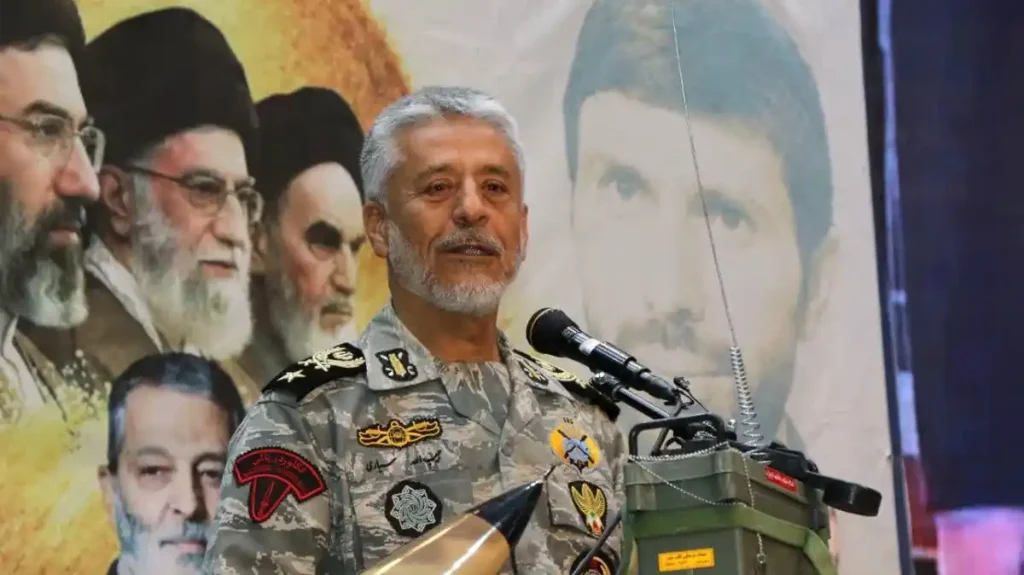
According to the official media office of the Islamic Republic of Iran Army and IRNA, Rear Admiral Habibollah Sayyari, Chief of Staff and Coordinator Deputy of the Army, addressed students at the Shahid Sattari Aeronautical University, identifying the triumph of the Islamic Revolution on February 11, 1979, as the inception of Western hostility toward the Islamic Republic. He emphasized that the imperialist powers’ core objective from the outset was to overthrow the nascent system and strike at the country’s territorial integrity—a strategy launched by inciting the Ba’athist regime to partition Khuzestan and resolve Saddam’s “geopolitical suffocation” in accessing open waters.
Comparative Analysis of the Three Imposed Battles and the Repetition of the Enemy’s Strategic Miscalculations
Detailing the three contemporary campaigns against Iran, the Army’s Coordinator Deputy stated:
1. The Eight-Year Imposed War: Direct Confrontation with the East-West Bloc Coalition
Admiral Sayyari stated that Saddam acted as the executor of a full-scale proxy war on behalf of the United States, receiving armaments within a 20-month span through an unprecedented consensus between the East and the West—a fact evidenced by the capture of military personnel from 27 countries during the Sacred Defense. He summarized the enemy’s miscalculation as underestimating the Army, adding:
“Before the engines of Iraqi fighter jets had even cooled following the bombardment of Mehrabad on September 22, 1980, the Army Air Force retaliated by striking Baghdad within two hours. The Ground Forces halted the rapid advance of the aggressor, and on the 67th day of the war, the Navy completely annihilated the Iraqi naval forces.”
2. The Twelve-Day War: Failed Partition Design Through a Proxy Arm
Referring to the 12-day war, Admiral Sayyari described its objective as aligned with that of the Sacred Defense: the overthrow and alteration of Iran’s geopolitical map. He noted that the Zionist regime entered the fray as the direct agent of the U.S. and Europe, but their hypothesis that the country’s defense structure would be paralyzed following the assassination of officials and internal social fragmentation was invalidated by national cohesion.
3. The Third War: Neutralizing the Scenario of Governance Collapse
Analyzing the dimensions of the third war, the Army Chief of Staff emphasized: The enemy’s strategy at this stage was predicated on creating a vacuum in the country’s leadership hierarchy and inciting crisis during the succession process. They believed that by eliminating the pillars of the regime and launching hybrid attacks on infrastructure, social control would slip away, but high levels of public insight and a cohesive management structure prevented this scenario from materializing.
The Equation of Resilience and Deterrence of the Armed Forces
Listing the fundamental commonalities of these three battles, Admiral Sayyari noted:
“The enemy’s common denominator across all three campaigns was a definitive failure to achieve its ultimate objectives. Without initiating aggression, we sustained heavy losses, and the martyrdom of the Supreme Leader was our greatest blow, but we never allowed global arrogance to execute its overthrow plot.”
Concluding his remarks by emphasizing that contemporary warfare is an arena of “wills and resilience,” he described the enemy’s hesitation to launch new aggression as stemming from despair over Iran’s defensive retaliatory capability and the unbreakable bond between the nation and the armed forces. “Surrender has no place in this nation’s lexicon,” he said, “and as long as the spirit of resistance flows among the country’s defenders, operational superiority will rest with the Islamic Republic of Iran.”