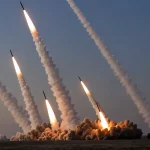
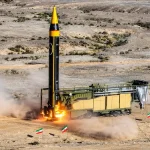
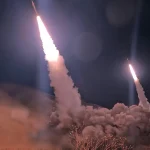
The Persian Gulf and the Strait of Hormuz witnessed one of the most intense military confrontations between Iran and the United States on Tuesday night. This conflict, which began with the IRGC Navy’s announcement regarding the seizure of an American unmanned intelligent submersible, escalated into a full-scale confrontation following America’s aggressive actions against Iranian oil tankers, leading to Iran’s decisive missile response.
Start of Tension: Hunting the Most Modern Intelligent Submersible
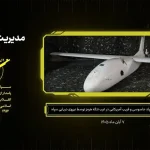
According to the IRGC Navy’s statement, the forces, during a complex intelligence operation at dawn on September 8th, managed to trap one of the most modern and newest unmanned intelligent submersibles of the US Army—which had joined the US naval fleet in 2025—at the entrance of the Strait of Hormuz.
Decisive Warning from the Armed Forces
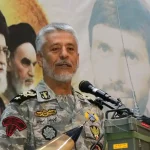
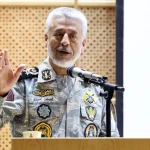
The seizure of this advanced equipment triggered an angry reaction and threats from the US to target Iranian oil tankers. In response to these threats, Major General Abdollahi, Chief of Staff of the Armed Forces, explicitly stated: “Any aggression against Iranian oil tankers will lead to the targeting of US bases in the region by the Armed Forces of the Islamic Republic of Iran.”
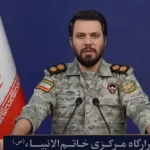
The Khatam al-Anbiya Central Headquarters and the IRGC spokesperson also emphasized the “No-Go Zone” policy in the Strait of Hormuz, announcing that any vessel passing through the sanctioned area (from Chabahar to the Sea of Oman and the Arabian Sea) would be denied all maritime support and insurance services.
Operation “Ya-Haidar Karrar”; Iran’s Decisive Response
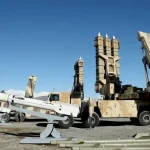
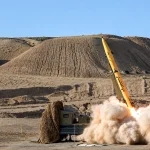
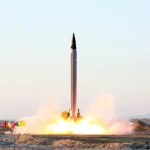
Ignoring the warnings, the United States attacked five Iranian oil tankers. Consequently, Iran’s armed forces initiated the operation to punish the aggressor under the code name “Ya-Haidar Karrar.” During this operation, the US “Al-Azraq” base in Jordan came under heavy ballistic missile fire, resulting in severe damage to the hangars housing F-35, F-16, and F-15 fighter jets.
Following this military response, the IRGC Aerospace Force targeted combat destroyers DDG-119 and DDG-53 with ballistic missiles, inflicting significant damage on these vessels, which were carrying cruise missiles. Furthermore, according to IRGC Statement No. 15, in response to American hostilities, 8 oil tankers and 2 US vessels, along with 10 trespassing ships attempting unauthorized transit through the Strait of Hormuz, were targeted.
Strategic Analysis: The End of the Era of Costless Threats
Political analysts view this operation as a shift in Iran’s power doctrine from classical components to “strategic power” or “resistance power.” Mohammad Hassan Zoragh, a political affairs expert, stated: “Iran’s capability to inflict maximum damage with minimal material resources has disrupted Western calculations.”
This confrontation proved that America’s most advanced intelligent equipment is vulnerable to Iran’s intelligence dominance. The recent operation sent a clear message to Washington and its allies in the region: the era of costless threats is over, and the Armed Forces of the Islamic Republic of Iran, relying on the three pillars of “intelligence superiority,” “national unity,” and “capability for symmetrical responses,” are fully prepared to impose heavy costs on any aggressor.